
Hansel and Gretel
Overview
“Hansel and Gretel” is a German folk tale collected and edited by Jacob and Wilhelm Grimm. It first appeared in 1812, as tale 15 in the first volume of their collection Children’s and Household Tales, often known in English as Grimms’ Fairy Tales. The story is commonly classified as a fairy tale and associated with tale type ATU 327A, within the broader group of stories about children and an ogre. The Grimms preserved and reshaped material from a tradition of storytelling; they did not originate every element of the tale themselves.
The story follows a brother and sister whose family faces severe hunger. In a familiar version, their father and stepmother take the children into the forest and abandon them. Hansel has overheard the plan and leaves a trail of small stones, enabling the siblings to find their way home. When they are abandoned a second time, he scatters breadcrumbs, but birds eat them, and the children become lost. They discover a little house made of bread, cake, and sugar and begin to eat from it. The house belongs to a witch, who lures them inside. She imprisons Hansel, intending to fatten him for a meal, and forces Gretel to work. Gretel tricks the witch into approaching the oven, pushes her inside, and frees her brother. The children escape with the witch’s valuables, find their way home, and reunite with their father. Details of the family situation and other episodes vary across versions.
Themes and background
Hunger is both the immediate cause of the children’s abandonment and the weakness the witch exploits. The story makes food a source of comfort and danger at once: the edible house appears to offer relief, but its apparent generosity conceals a trap. The forest similarly has a double role. It is a place of exposure and disorientation, cut off from adult protection, but it is also the setting in which the children must learn to respond to danger for themselves.
The siblings’ resourcefulness and loyalty give the tale much of its emotional force. Hansel first tries to lead them home, but his breadcrumbs cannot serve as a lasting guide. When the children are imprisoned, Gretel becomes the decisive rescuer, recognizing the witch’s plan and using a feigned lack of understanding to outwit her. Their return and reunion offer a movement from deprivation toward safety, while the tale’s violence and its threat of cannibalism keep the resolution from erasing the dangers that preceded it. The narrative can therefore be read as a story of sibling solidarity, survival, maturation, and the vulnerability of children in a world governed by scarcity.
The Grimms gathered German-language tales in the early nineteenth century as part of a broader scholarly interest in language, literature, and cultural history. Their collection was revised and enlarged over successive editions: it began in 1812, appeared in two volumes in 1812 and 1815, and reached its final edition in 1857. The brothers’ editorial work helped turn orally transmitted and otherwise circulating stories into a widely read literary collection. Some modern accounts connect “Hansel and Gretel” with historical famine, including the European famine of 1315–1317, but such a direct origin is an interpretation rather than an established fact about how the Grimms collected the tale.
Influence and standing
The edible cottage, the lost children, and the witch at the oven have made “Hansel and Gretel” instantly recognizable. The tale has circulated in translations and adaptations for children and adults, including illustration, theater, and other retellings. Its simple, memorable plot supports very different emphases: a frightening adventure, a moral tale about caution, or a more troubling reflection on poverty, abandonment, and adult responsibility. Alongside other works in the Grimms’ collection, it has helped shape international ideas about the European fairy tale. Its lasting appeal lies partly in that contrast: the siblings achieve a hopeful return, but only by confronting a story world in which hunger makes home unsafe and sweetness can conceal a deadly threat.
About the Author
Origins and education
Jacob Grimm and Wilhelm Grimm were German scholars, linguists, and collectors and editors of folk narratives. Jacob was born on January 4, 1785, and Wilhelm on February 24, 1786, in Hanau, in the landgraviate of Hesse-Kassel. They spent part of their childhood in Steinau and later studied in Kassel. Their father, Philipp Wilhelm Grimm, worked in law and died while Jacob was still young, leaving the family in difficult circumstances. The brothers attended school in Kassel and both went on to the University of Marburg to study law. There they encountered the influence of the legal scholar Friedrich Carl von Savigny and developed broader interests in medieval literature, language, and German cultural history.
The brothers were close collaborators throughout their lives, though they had distinct temperaments and scholarly strengths. Jacob was often described as the more reserved of the two. Their shared interests led them from legal studies toward philology and the history of Germanic culture. Their early family hardships form part of their biography, but should not be treated as proof that the tales they collected were autobiographical.
Scholarship and major works
In 1808 Jacob became a librarian to the king of Westphalia. The brothers began collecting and editing folk narratives during this period, and in 1812 they published the first volume of Children’s and Household Tales. A second volume followed in 1815. The collection was revised and enlarged over the years, culminating in its 1857 edition. It became internationally known as Grimms’ Fairy Tales and included stories such as “Snow White,” “Cinderella,” “The Frog Prince,” and “Hansel and Gretel.” The Grimms were not simply stenographers of oral performances: they selected, arranged, and edited material, and the successive editions reflect their sustained editorial work.
Their scholarship extended well beyond folklore. Jacob’s multi-volume German Grammar appeared between 1819 and 1837 and became a major work in historical linguistics. The sound-change principle known as Grimm’s law is associated with his research. His German Legal Antiquities was published in 1828, and his studies also included German Mythology (1835). Wilhelm contributed to research on medieval German literature and legend, as well as to the brothers’ joint editorial projects. Together they undertook the enormous German Dictionary, begun in 1852, a project that remained unfinished at their deaths. Their lasting importance therefore rests both on the literary influence of the tales and on their foundational work in German philology and cultural history.
Public life and legacy
The brothers held academic positions in Göttingen. In 1837 they joined five other professors in protesting the Hanoverian king’s abolition of the constitution. The seven scholars were dismissed, and the episode became known as the Göttingen Seven affair. In 1840 Jacob and Wilhelm moved to Berlin and became members of the Prussian Academy of Sciences, continuing their research and collaborative work there. Wilhelm died on December 16, 1859; Jacob died on September 20, 1863.
The Grimms are remembered as influential scholars as well as collectors and editors of stories. Their collection helped preserve and popularize narratives that had circulated through oral and literary traditions, while their linguistic research shaped the development of German studies. Repeated editions, translations, and adaptations brought the tales to readers around the world. Their names remain closely associated with the fairy-tale tradition, but their reputation also reflects a much wider scholarly enterprise devoted to language, law, literature, and the history of German culture.
StoryFlow
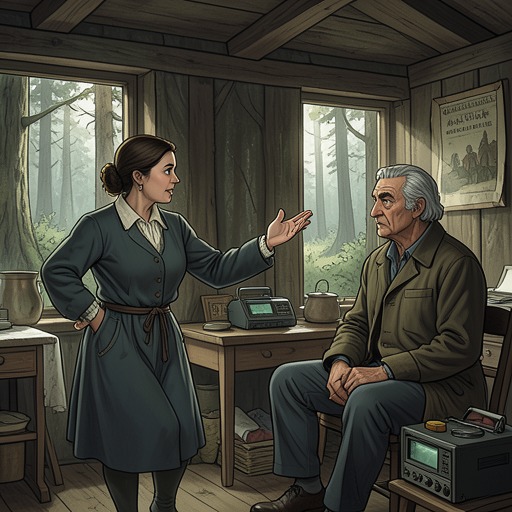
The Family’s Abandonment
The family’s hunger turns a reluctant decision into two attempts to leave the children in the forest, before their return ends the crisis.
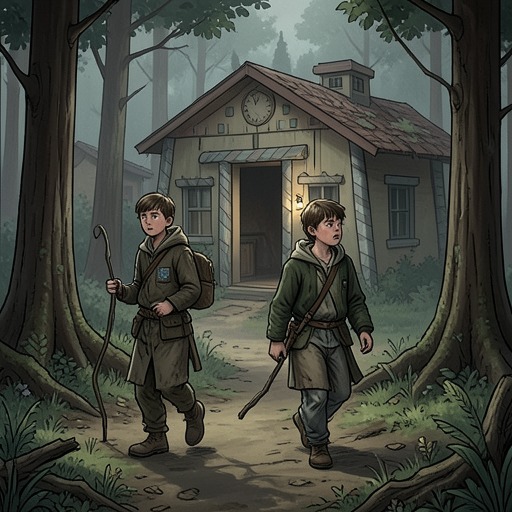
The Children’s Journey
Hansel and Gretel move from endangered dependents to resourceful survivors who escape the forest and return home.
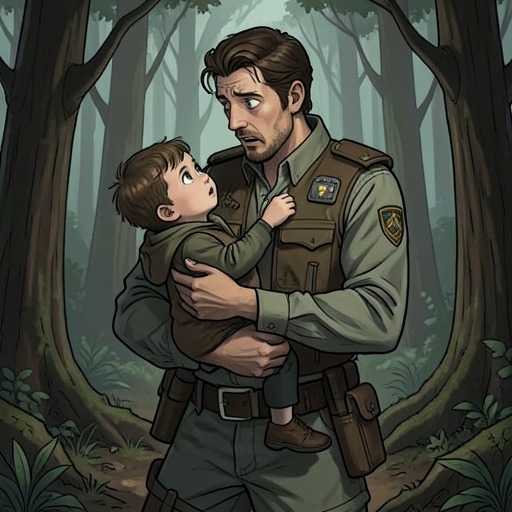
The Woodcutter’s Choice
The Woodcutter’s affection for his children is repeatedly overcome by fear and pressure, then returns as remorse at their homecoming.
